← Gallery · Roll 03 / 06 · Incident response and on-call
Lull
An engineer paged at 3 a.m. wants the outage gone and their bed back, until four keys turn the whole night into one short, well-cut sequence.
Screening
The live production, running below. Scroll inside it.
The treatment (treatment.md)
Written by the agent during production, unedited.
Open the full treatment
Lull — treatment
Fictional B2B SaaS: incident response and on-call. English, long copy (see copy.md). Demo; every figure illustrative.
1. Development
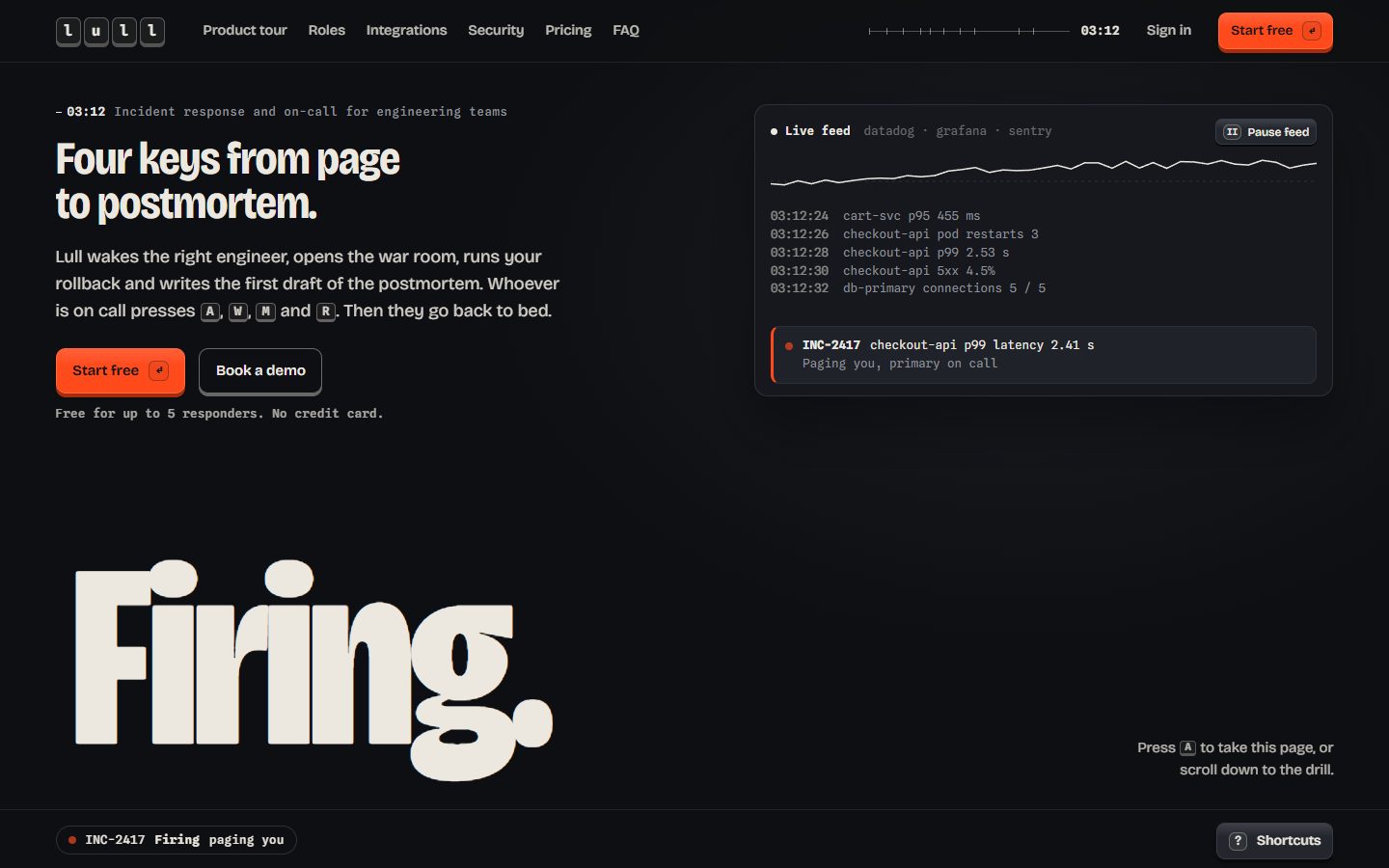
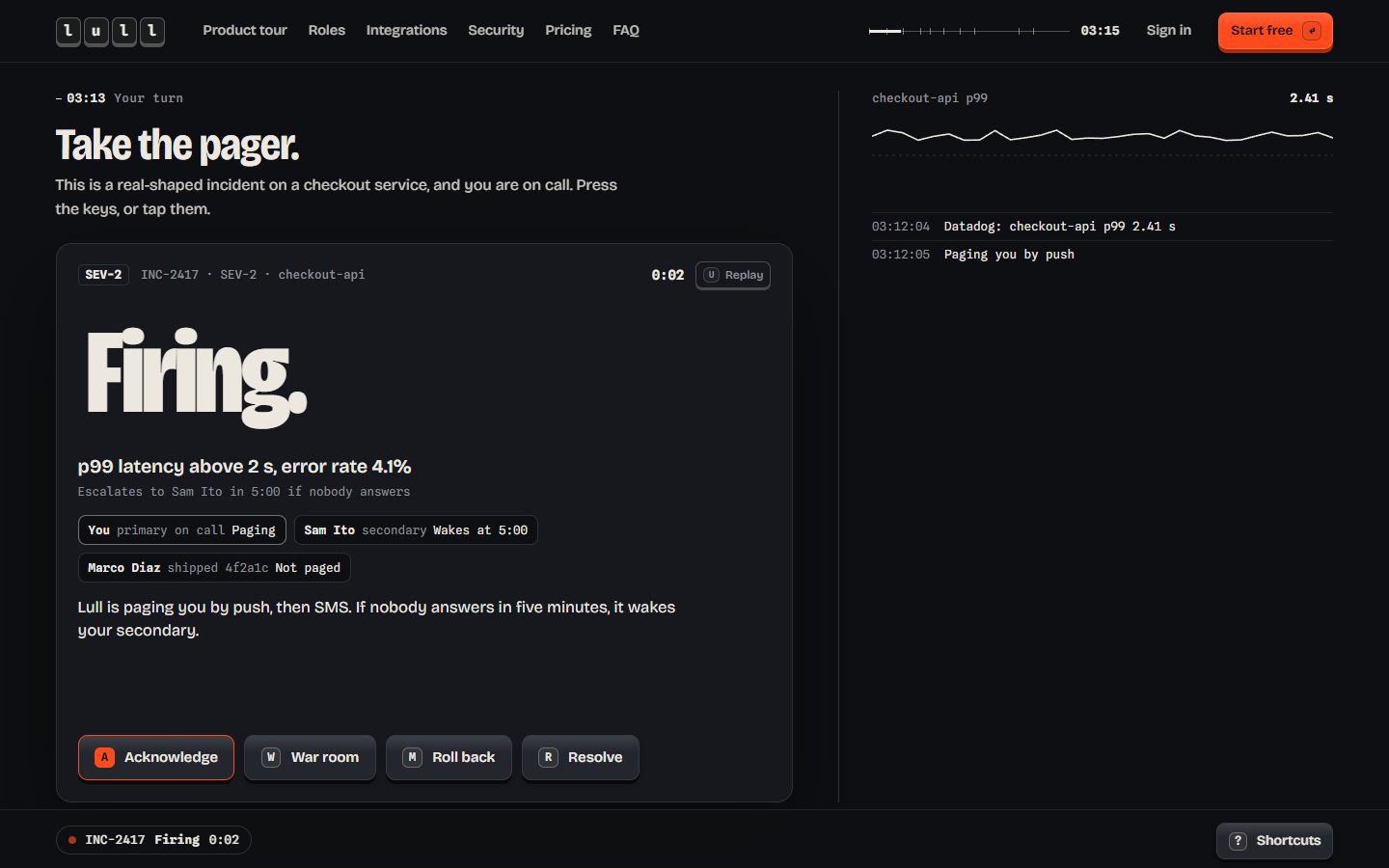
Product truth. Lull pages the right engineer, opens a war room with whoever shipped last, runs the mitigation attached to the service and drafts the postmortem from the timeline. Every one of those is a single key: A acknowledge, W war room, M mitigate / roll back, R resolve.
Primary action: Start free (Free tier, 5 responders, no card). Secondary: Book a demo (Business / security review). Pricing visible: Free / Team / Business + comparison.
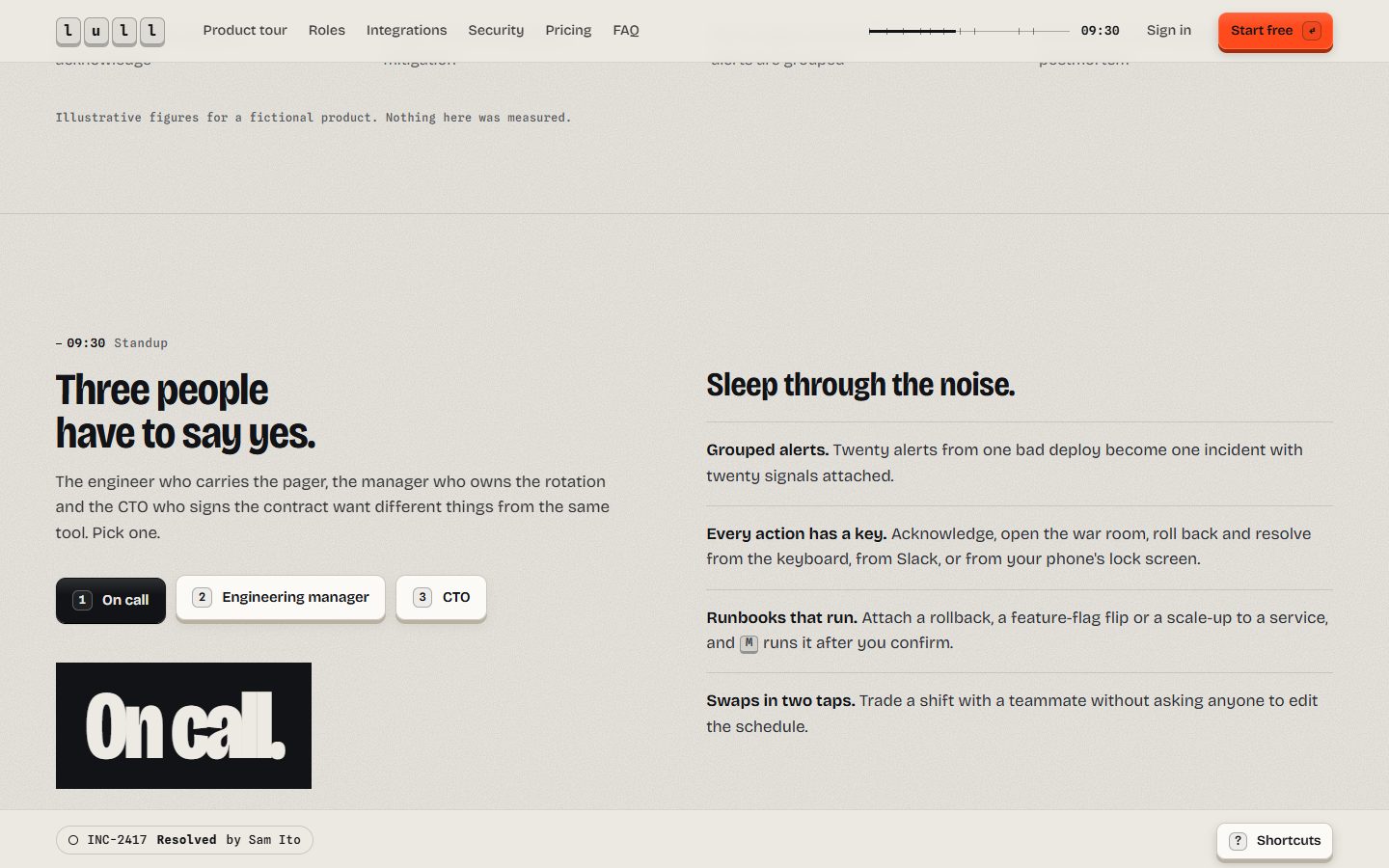
Audience. Solution-aware to product-aware: they already run a pager and are comparing. Buying committee: the SRE on call (user, cares about noise and sleep), the engineering manager (owns the rotation, cares about load and follow-through), the CTO (signs: reliability, audit, spend).
Logline. An engineer paged at 3 a.m. wants the outage gone and their bed back, but the page lands on the wrong person, the room has nobody who shipped the change and the postmortem never gets written, until four keys turn the whole night into one short, well-cut sequence.
Audience arc. Arrive: "incident tooling is a heavy console I fight at night." Leave: "with Lull the night is four keystrokes I just performed myself, and it is priced per person who actually gets paged."
2. Casting session
Dramatic problem: dread into rhythm. On-call is fear of the unknown; the product's promise is that the response becomes muscle memory with a tempo. The page must feel quick and composed, never frantic.
| Candidate | Mechanism that solves it | Signature shot | Risk | Wrong for |
|---|---|---|---|---|
| Edgar Wright — Baby Driver (2017; DP Bill Pope, ed. Paul Machliss & Jonathan Amos) | Action cut to a track: every door, gear change and shot lands on a beat, so chaos reads as choreography | The opening getaway, cut to the song; the "Harlem Shuffle" coffee run where the lyrics appear written on the street behind Baby | Can tip into music-video cuteness | Anything solemn, slow or luxury |
| Kathryn Bigelow — The Hurt Locker | Procedural calm under threat: one wire, one step, a countdown, the suit | The walk to the device in a long lens, heat shimmer | War imagery on a SaaS page is tasteless; its tempo is a slow burn, wrong for click and key energy | Products that must feel fast and light |
| Steven Soderbergh — Ocean's Eleven | The plan explained while it is executed; each specialist recruited with one insert | The crew assembling, the vault plan over the action | Heist slickness is a costume ("the team" cliché) and the yellow grade is a cliché of its own | A product about restraint |
Cast: Edgar Wright, Baby Driver. The product is literally a sequence of keypresses; Wright is the director whose mechanics are percussive inserts and action on the beat. Bigelow set aside for tone and tempo; Soderbergh set aside because the heist would be costume, not mechanism. Competitor test: another pager could not use this unchanged: the film is built on Lull's four keys, their named states and the visitor's own time to resolve, which persists into the ending.
Filmography check (last three: Fincher Zodiac, Anno Shin Godzilla, Sciamma Portrait): differs on director, medium (live product UI on a beat grid, not a drawn line / typeset documents / 3D glass), form (key-driven fixed-stage drill inside a document), type (Latin Bricolage Grotesque + Spline Sans Mono), lead (one incident's status), interaction (resolve an incident by keyboard), ending (status word swaps to "Quiet." with your own time in the line), instruments (keycaps, clock of the night, incident chip).
Mechanisms (each visible on screen)
- Action cut to the track → a 112 bpm beat grid. In the drill every keypress lands at once, and its consequences (Slack note, escalation cancelled, status page) post to the timeline on the next beats; a beat dot in the incident chip pulses while the incident fires. (drill, chip)
- The lyrics written on the set ("Harlem Shuffle" oner) → the copy's words live inside the product UI: the hero's live feed carries the incident, the drill's status word is the headline, section eyebrows are timeline timestamps (03:13 · Your turn … 23:00 · Quiet). (hero, drill, every section)
- Percussive inserts of mundane actions (gear stick, keys, coffee lids) → each key pressed cuts in a close-up of that keycap for one beat at the corner of the console. (drill)
- Baby picks the track; the job waits for it → the incident clock does not start until the visitor takes the pager; their time to resolve is theirs. Rewind (Baby restarts a song) → U replays. (drill, chip, final)
- Whip pans hide the joins → role tabs whip their panel sideways with a short smear; the cube-flip word tips like a key. (roles)
- Hard stops on the punchline → every move is expo/power-out, 0.2–0.5 s, zero overshoot (cube-flip's small back-out is the only give, on a key that has mass). (everywhere)
- The silence after the music (Baby's tinnitus hum, the ending's quiet) → after R the beat dot stops, the accent leaves the chip, and the last scene swaps "Resolved." to "Quiet." (chip, final)
3. Medium
Designed: the product UI is the world's material. A live, simulated console (DOM + inline SVG sparklines), keycaps as physical objects (top face, wall, travel on press), set type, a paper ground with a fine grain for the day and a night ground with a monitor glow. No canvas, no photographs, no AI images. This film's mechanism (action cut to a beat) becomes keypresses, timestamps and status swaps because the product's own drama happens in keystrokes and log lines. Why not 3D: nothing here is solid or glossy; the tension is timing. A rendered keyboard would be a prop.
4. Lead, location, assets
Lead: incident INC-2417's status (the big status word + its card). Verb: resolve. States: Quiet (loader) → Firing (hero) → Acknowledged → War room → Rolled back → Resolved (drill, by the visitor's keys) → Postmortem (draft card, highlighter) → Quiet (final, your time). Location: one night on call, 03:12 to 23:00. Night console → dawn (the ground turns to paper) → a working day of documents (standup, wiring, security review, budget, questions) → night again, quiet. Assets: none requested. All type, CSS and SVG; no library media, no generation. Real logos are not used: integrations are names only, marked illustrative.
5. Award pass
WORLD OBJECT   the keycap: loader (l·u·l·l typed), wordmark, every button and CTA (top face + wall + travel),
               tabs, pricing toggle, the "?" sheet, drill keys and inserts. Second object: the incident
               timeline timestamp, which heads every section and drives the clock instrument.
LEAD STATES    Quiet → Firing → Acknowledged → War room → Rolled back → Resolved → Postmortem → Quiet
LOADER         shot one: four keycaps type l·u·l·l at the wordmark position (one per beat) while the
               status word swaps Quiet. → Firing. The headline and Start free are in the DOM and on
               screen from first paint; the loader is the first 1.2 s of the hero, not a wall.
CUT MATERIAL   hero → drill: the alert row opens (clip expands from the INC-2417 row of the feed to the
               full frame — the gesture of opening an alert). drill → dawn: the swap bar at frame scale,
               in paper (the morning arrives as the bar). Flow sections and the final night push (a hard
               edge rising; the kit's overlap cut would hide the FAQ's last screen under the final frame).
               Exception: tab panels whip sideways (mechanism 5).
ACCENT         signal red-orange #FF4A1C = "needs a human: your move". The firing bar, the next key to
               press, the beat dot while firing, the cause to confirm, and the Start free keycap (the
               visitor's move). Leaves the chip after Resolve. Budget ≤ 4 % of any frame.
TYPE           Bricolage Grotesque (display at wdth 75 / opsz 96 / 800; text at opsz 14 / 400) +
               Spline Sans Mono (keys, timestamps, figures). Switch device: the keycap — any key named in
               a line is set as a real <kbd> cap. Display at the extreme: the status word 15–17 vw (hero,
               final) / ≤ 9 vw in the console; H1/H2 deliberately small (≤ 3.4 vw) because the status
               word carries the scale.
INSTRUMENTS    1 top-left wordmark of four caps · 2 top-right Start free keycap (↵) · 3 top hairline clock
               of the night 03:12 → 23:00 with section ticks (scroll) · 4 bottom-left incident chip
               (INC-2417 · state · your timer · beat dot) · 5 bottom-right "?" keycap: shortcut sheet.
VERB           resolve an incident by keyboard: A, W, M, R (tap on touch). Your time persists.
TRIGGERS       scrub: hero→drill opening, dawn read-fill + ground, clock. Entry-then-play: stats odometers,
               final swap. Autoplay: loader, live feed, beat dot. Click/tap: keys, tabs, pricing toggle,
               dialogs. Keyboard: A W M R U ?, arrows on tabs. Hover/focus: integration previews.
               Idle: the drill prompts the next key after 6 s. Input: responders → monthly total.
TYPE CAST      signature headline-swap (opening autoplay, drill keys, final entry) + cube-flip (tabs),
               odometer (stats on entry, prices on toggle), select-box (integration preview on hover),
               highlighter (postmortem cause, on R), read-fill (dawn statement, scrub).
RHYTHM         set pieces: hero, drill, dawn, final. Calm documents: numbers, roles, wiring, security,
               pricing, FAQ (≈ 70 % of the scroll). Phone: the drill re-blocks to status word on top and a
               thumb bar of four keys at the bottom; tables scroll inside their own box.
6. Trigger table
| # | Beat | Performance | Trigger | Keyboard / touch path | Reduced motion |
|---|---|---|---|---|---|
| 1 | Loader | four caps type l·u·l·l at the wordmark | autoplay (intro, once) | none needed (decor) | caps shown at rest |
| 2 | Hero | status word Quiet. → Firing. (headline-swap) | autoplay (intro, 0.9 s) | n/a | "Firing." at rest |
| 3 | Hero | live feed: log lines on the beat, latency sparkline, beat dot | autoplay loop, paused off-screen | Pause feed keycap (Space/Enter) | paused composed still + Play key |
| 4 | Hero → drill | the INC-2417 row opens into the console | scroll scrub (cut) | Page Down / swipe | hard cut |
| 5 | Drill | A / W / M / R: status swap, keycap insert, timeline posts on the next beats | keyboard + click/tap | keys A W M R; buttons (Tab + Enter); tap | instant state, no insert |
| 6 | Drill | the next key pulses and the caption asks for it | idle (6 s without input while on stage) | same keys | static "next" ring |
| 7 | Drill | U rewinds to Firing (swap backwards) | keyboard + click | U / Replay button | instant |
| 8 | Drill (after R) | postmortem cause highlighted | keyboard/click event (R) | as 5 | marker at rest |
| 9 | Dawn | statement lit word by word (read-fill) and the ground turns from night to paper | scroll scrub | scroll / Page Down | lit, paper |
| 10 | Numbers | four odometers roll once to their exact value | scroll entry, then play | n/a | final values |
| 11 | Roles | cube-flip role word + panel whip | click / tap | ←/→ on the tablist, Home/End | instant switch |
| 12 | Wiring | preview updates, select-box frames the tool name | hover / focus / tap | Tab to a tile; tap | box at rest |
| 13 | Pricing | Monthly ↔ Annual: prices roll (odometer) | click / tap | Tab + Enter/Space | instant values |
| 14 | Pricing | responders → monthly total | type / input | number field, arrows | same |
| 15 | Final | status word Resolved. → Quiet. | scroll entry, then play | n/a | "Quiet." at rest |
| 16 | Chrome | shortcut sheet opens | keyboard ("?") + click | ? / Esc; button | instant |
| 17 | Chrome | clock of the night 03:12 → 23:00 | scroll scrub | n/a | follows scroll |
Scroll-scrubbed: 4, 9, 17 → 3 of 17 performances.
7. Type cast
| Effect | Job | Trigger | Where |
|---|---|---|---|
| headline-swap (signature) | the lead changes state: a bar wipes, the status under it is replaced | autoplay (opening), keyboard/click (drill), scroll entry (final) | hero status word, console status word, final status word |
| cube-flip | a choice with mass: the role word is a key face that tips to the next | click / arrows | Roles tab headline |
| odometer | a real figure arrives and stops exactly | scroll entry (stats), click (pricing toggle) | Numbers, Team/Business prices |
| select-box | inspector-style frame on the tool being previewed (DevTools' own gesture) | hover / focus / tap | Integration preview heading |
| highlighter | points at the one line a human must confirm | keyboard/click (R) | Postmortem draft cause |
| read-fill | the statement read aloud by the scroll | scroll scrub | Dawn |
8. The audience's part
Action       press A, W, M, R in order (or tap the keys) while the console is on screen
Response     the key travels, a close-up insert cuts in, the status word swaps, the timeline posts on the beats
Consequence  the incident stays resolved for the rest of the page: chip "Resolved in 0:41", accent gone,
             postmortem card, and the final line quotes your time; U replays from Firing
Equivalent   buttons with labels (Tab + Enter), tap on touch; the wrong key gets a one-line hint
9. Shot list
| # | Scene | Copy | Shot / blocking | Light / colour | Build | Cut out | Length | Energy | Money frame | Mobile |
|---|---|---|---|---|---|---|---|---|---|---|
| 1 | page (hero) | eyebrow, H1, sub, CTAs, feed | wide: H1 small top-left, live feed right, status word huge across the bottom | night ink, monitor glow behind the feed, accent bar on "Firing." | intro, feed loop, swap | the INC row opens (data-cut 100) | 240, data-hold (the feed is the development) | 6 | feed running, "Firing." landed | stack: H1, CTA, feed 3 lines, word 24 vw |
| 2 | drill | eyebrow, h2, console, captions, postmortem | medium: console left, timeline right; insert keycap close-up | night, accent only on the next key | state function render(x, s); keys; idle | swap bar, paper (data-cut 80) | 340, data-hold | 8 (performed) | Rolled back / Resolved | status top, log 3 lines, thumb bar |
| 3 | dawn | statement | close: one paragraph, 1.6–2.4 vw | ground night → paper while the words light | read-fill + colour scrub | push | 260 | 3 | half lit, ground turning | 6.4 vw text |
| 4 | numbers | four stats | wide row of four big figures, hairline rules | paper | odometer on entry | push | flow | 4 | figures landed | 2×2 |
| 5 | roles | tabs, cube word, 4 features ×3 | split: tabs + cube word left, panel right | paper | tabs, cube-flip, whip | push | flow | 4 | CTO panel | tabs scroll, panel below |
| 6 | wiring | 12 tools, preview | dark slate panel of keycap tiles + preview card | slate (a monitor in the room) | hover preview, select-box | push | flow | 4 | Grafana selected | tiles 2-col, preview first |
| 7 | security | list + reliability note | document column with a ruled audit-log list | paper | none (calm) | push | flow | 2 | — | — |
| 8 | pricing | 3 tiers, toggle, calculator, table | three keycap-edged plans, Team raised; table below | paper, accent on Start free only | odometer, input | push | flow | 5 | annual, Team | stacked, table scrolls in box |
| 9 | faq | 7 Q&A | two columns: heading left, details right | paper | native details | push | flow | 2 | — | one column |
| 10 | quiet (final) | eyebrow, h2, line, CTAs, the feed gone quiet | rhyme of shot 1: status word huge across the bottom, the same feed panel now flat and filed | night by push; accent only on Start free | swap on entry (grey bar) | footer | 130, data-hold | 5 | "Quiet." + your time | as hero |
10. Skeleton
Energy: cold open at 6 (it is already firing) → spike at the drill (performed, 8) → long calm plateau of documents (2–5) → small lift at pricing → a quiet close. Turn: the visitor's R (~22 % of the scroll, when they act). Opens mid-action (an alert already paging). Ends on a rhyme: the hero's frame, same word position, the incident gone, your time in the line.
11. CRO decisions
- One primary action, everywhere the same: "Start free" as the only accent keycap (chrome, hero, Free plan, drill end, final). "Book a demo" is the outline keycap, aimed at Business / security review.
- Awareness: solution/product-aware → lead with the mechanism (four keys) and let them perform it, then proof, roles, wiring, security, price. Pricing is visible, no "contact us" walls except >200 seats.
- Committee: the Roles tabs answer each signer in their language (sleep / load / cost and audit).
- Objections next to the action: "No credit card" under every Start free; "viewers are free" at the price headline; refund window under the plans; Slack-down paging in Security and FAQ; migration and runbook prerequisites in FAQ; calculator turns per-seat into a monthly figure.
- Pricing: price metric = responder (people who can be paged), which matches value and removes the "penalises adoption" risk for viewers. Three tiers by situation, Team marked "Most teams start here" with a reason (real rotation). Annual default, monthly one click away, saving stated as a number.
- Friction: sign-up asks two fields (work email, team name); demo asks four; both state what happens next.
- Proof honesty: all numbers labelled illustrative; no testimonials invented.
Every production on this site is a fictional brand. The output is real: made by agents using the skill.