← Gallery · Roll 04 / 06 · Design studio portfolio
Odd Lot
A marketing lead who has seen a hundred portfolios that look alike wants a studio that can make her brand impossible to miss; five pieces of work that look nothing like one another prove this one can.
Screening
The live production, running below. Scroll inside it.
The treatment (treatment.md)
Written by the agent during production, unedited.
Open the full treatment
Fictional design studio (Rotterdam), fictional clients and projects. English demo, short copy.
1. Development
- Product truth. A nine-person studio that makes identities, packaging, typefaces and motion. What it can honestly claim is its work; everything else (numbers, quote, prices) is invented for the demo and labelled.
- Audience. Brand and marketing leads with a shortlist of three to five studios. They arrive skimming, they decide on the work, and they want to know what happens after they write in.
- The one action. Start a project: a five-field brief, or email. Secondary: see the work.
- Logline. A marketing lead who has seen a hundred portfolios that look alike wants a studio that can make her brand impossible to miss; five pieces of work that look nothing like one another prove that this one can, and she ends by watching the studio set her own project's name.
- Audience arc. Arrives: "another studio site, another grid of mockups." Leaves: "every project here looks like its client, not like the studio. They'll do that for us, and I know what happens after I write."
2. Casting session
Dramatic problem: range and nerve, proved fast. The studio has to look like it has a point of view and also like it disappears into each client.
| Candidate | Mechanism that solves it | Signature shot | Risk / wrong for |
|---|---|---|---|
| Jean-Luc Godard — Pierrot le Fou (1965, Raoul Coutard, Techniscope) | Collage of found objects (paintings, comics, adverts) cut into a story; words as images; primary colour as structure; the film addressing its audience | The opening credits whose letters appear in alphabetical order, blue and red on black | Risk: arch and cold; quotations as costume. Wrong for anything that needs warmth or a single product |
| Saul Bass — title sequences (Vertigo, Anatomy of a Murder) | One cut-paper symbol that becomes the whole idea | A bar that becomes a column that becomes the logo | Built for a single symbol; a studio of five different clients would be forced into one shape. Also the obvious pick for "design studio" |
| Edgar Wright — Baby Driver | Process as snap-cut inserts, transitions hidden in whips, everything on a beat | A row of percussive inserts cut to a track | Rhythm without dwelling: the index needs the visitor to linger on a piece of work; a whip-cut site is a showreel, not a portfolio |
Cast: Godard, Pierrot le Fou. A studio portfolio is a collage of other people's objects, so the film's habit of inserting found material is native rather than decorative. Bass set aside because his single symbol cannot hold five clients; Wright set aside because his cutting never lets the eye rest on a piece of work.
Could a competitor use this direction unchanged? No: the lead is this studio's own artboard, the loader is its own name sorted A to Z, and the ending is the visitor's own project title.
Mechanisms (observable in the film → visible on the page):
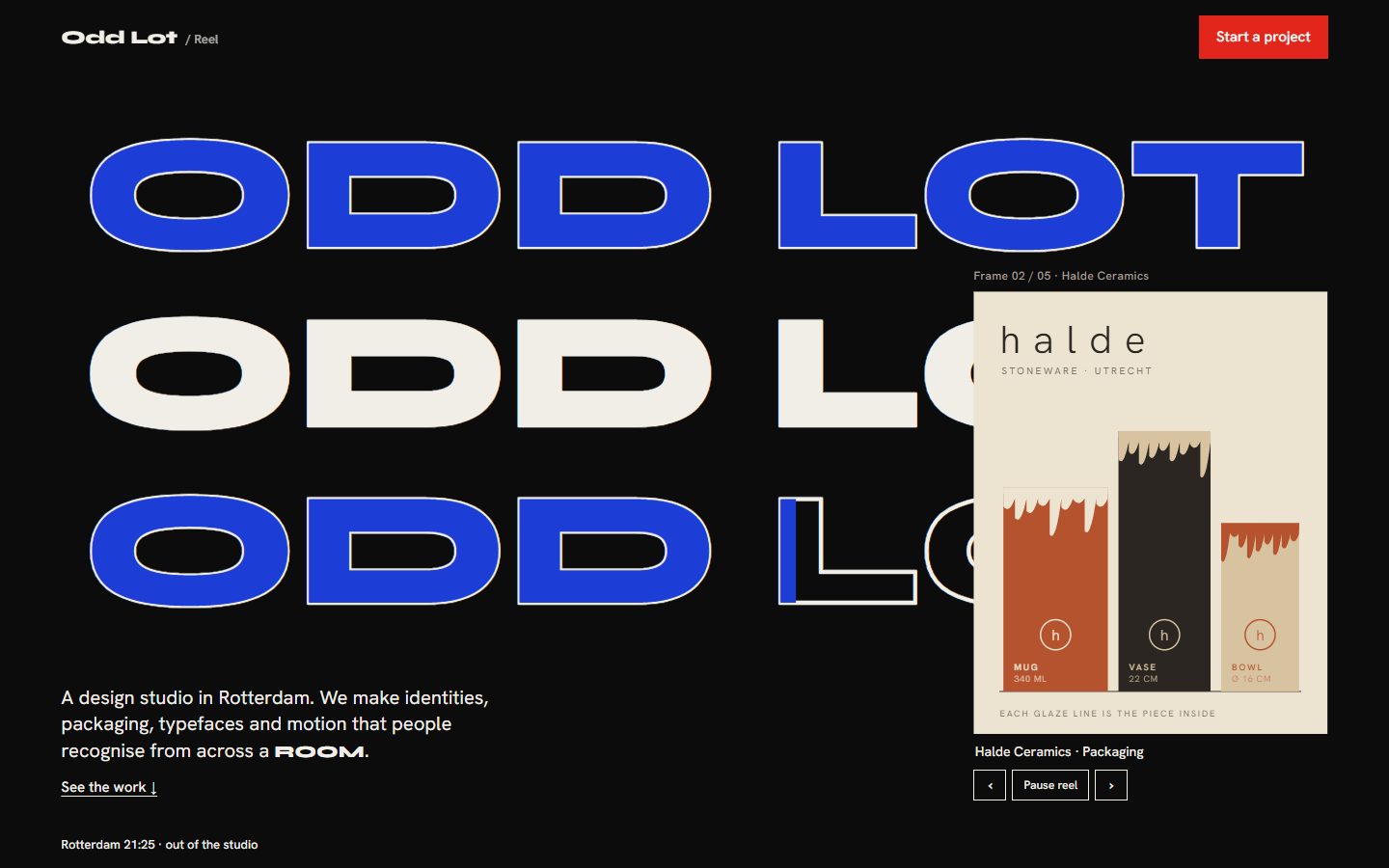
- Credits in alphabetical order. The opening titles' letters arrive A to Z rather than in reading order → the loader: O-D-D L-O-T lands as D, D, L, O, O, T, blue and white on black, already at hero size. (Frame 1.)
- Coloured light sliding over the windscreen in the night drive → the showreel's cut: a band of blue-white light crosses the artboard and the work changes under its brightest point. (Hero, autoplay.)
- Primary colour as structure → each project opens on a flat card in its own colour; the studio's only red means "act here".
- Words as images, title cards that interrupt the action → opening a project first shows its name as a full-frame card in outline rows, then the work. (Project open.)
- Direct address to camera → when the visitor stops, the page speaks to them in the status corner, and what it says depends on where they are. (Idle.)
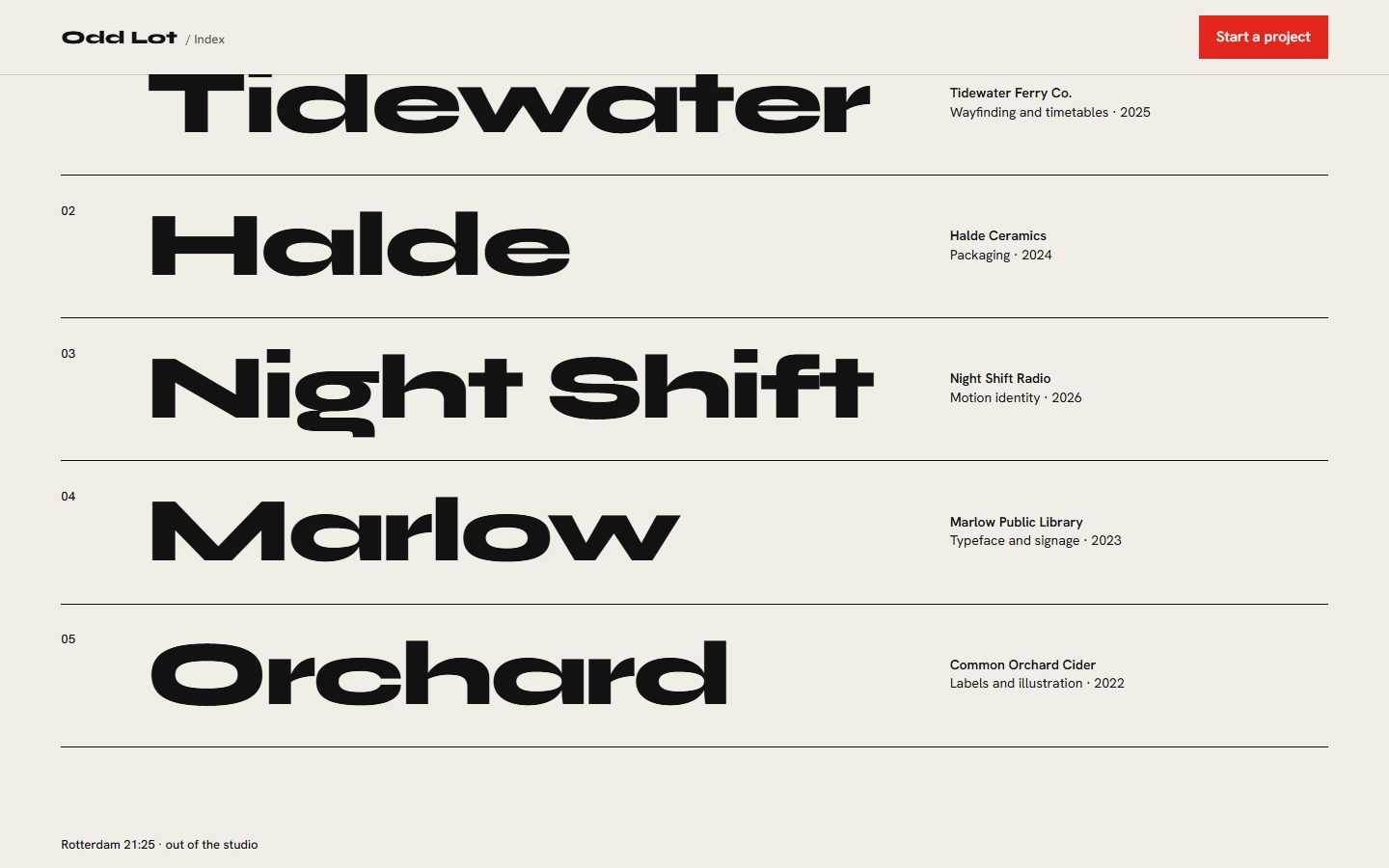
- Collage of found material → five artefacts that share nothing but the artboard they sit on: transit poster, ceramic boxes, broadcast mark, type specimen, cider label. (Index.)
- The jump cut → a project opens with a designed transition and closes with a jump: one frame and you are back at its row, marked as seen. (Close.)
Filmography check (last three: Sciamma / Retour, Anno / Tieout, Fincher / 北辰). Differs on director, medium (flat primary cards + SVG artefacts, Latin type, no paper, no line, no 3D), form (hover index + click-opened overlay, one short scrubbed scene), type (Syne 800 + Hanken Grotesk, Latin), lead (the artboard), interaction (hover-to-preview, then title your own project), ending (the visitor's title on the card), instruments (frame-label breadcrumb, reel counter with pause, live studio clock that turns into direct address). Eight of eight.
3. Medium
Designed: flat primary cards, set type and five inline-SVG artefacts drawn for the demo, no canvas, no photographs, no generated images. Godard's collage becomes a page of distinct designed objects pinned to one artboard because the work, not a camera, is what a buyer is judging. Why not 3D: the film is flat colour, cards and print; depth would turn the work into mockups.
4. Lead, location, asset call
- Lead: the artboard. A flat rectangle with a frame label at its top-left corner, the studio's own working surface. Verb: it sets things (titles, holds, presents). States:
- Empty frame on black (loader): the label draws, the name's letters land A to Z.
- Reel (hero): the artboard plays five projects under passing light.
- Preview in the hand (index): small, it follows the pointer as a tool.
- Title card (open): it grows from the preview to the whole frame, in the client's colour, carrying the project's name.
- The work, whole (case): the artefact at full size.
- Seen (index after close): a small blue mark stays on the row.
- Yours (enquiry): the card titles itself with the visitor's working title; on sending, its last row fills red.
- Location: a black projection room (hero, enquiry) and a paper table (index, statement, facts), lit flat; colour comes only from the cards.
- Asset call: none to make. Brief excludes paid generation; all five artefacts are drawn as SVG for the demo (stand-ins for real client work). Marlow's typeface is shown with Fraunces (OFL) as a stand-in. No open-licensed images used, so no credits beyond fonts.
5. Screenplay
All visible words are in copy.md.
6. Storyboard
Form: a short document with set pieces. Hero (flow, autoplay), index (flow, hover), one pinned scrubbed statement, facts (flow, enter-play), enquiry (flow, input), footer (flow, autoplay). Projects open in a fixed layer above the page with a real URL hash (#/work/tidewater), so the scroll position never moves under them.
Award pass
WORLD OBJECT   the artboard: a flat rectangle with a frame label top-left (name · index · size). Loader (label draws, name lands), cuts
               (preview artboard grows into the project card), CTA (red artboard with four selection handles on focus), cursor (red
               "Open" chip on the preview), progress (frame-label breadcrumb "Odd Lot / Index / 03 Night Shift Radio"), enquiry card, footer.
LEAD STATES    empty frame → reel → preview in the hand → title card → the work → seen mark → your title, last row red
LOADER         black; frame label draws; ODD LOT arrives A→Z (D D L O O T), solid; the solid letters drain to outline as the
               outline rows rise: the loader becomes the hero's signature move without a cut
CUT MATERIAL   light (the reel's band of blue-white light), the artboard itself (preview → full card, clip from its own rect);
               the exception: closing is a jump cut, no motion at all
ACCENT         red #E2261C = "start something here": CTA, cursor chip, the enquiry's final row; ≤ 3 % of any frame.
               Blue #1D3ED6 is structure (cards, fills, seen marks), not accent
TYPE           Syne 800 display (extended, French) · Hanken Grotesk 400/500 text · switch: one word per line in Syne caps
               inside the text face ("the cap word"). Display at the huge extreme: name 11–13 vw, project titles on cards 10+ vw
INSTRUMENTS    top-left frame-label breadcrumb (where you are), top-right red CTA (pole star), bottom-left studio clock
               "Rotterdam 14:32 · in the studio" that becomes the idle line, hero reel counter "02 / 05" with pause
VERB           the visitor titles their project and watches the studio set it (input), after choosing work by pointing at it
TRIGGERS       autoplay (loader, reel, name, footer) · hover/focus (index preview, select box, CTA) · click (open, pause, step,
               send) · scroll scrub (statement only) · scroll enter-play (facts) · input (enquiry card) · idle (direct address)
               · time of day (clock). 1 of 15 performances is scrubbed
TYPE CAST      signature outline-fill (opening, turn, ending) + headline-swap, select-box, odometer, read-fill, typewriter,
               stretch, giant-marquee
RHYTHM         set pieces: hero, project open; calm documents: index, statement, facts, enquiry. Phone: index rows become
               tap-to-select with a bottom preview sheet; hero stacks name over a square reel
Trigger table
| Beat | Performance | Trigger | Keyboard / touch | Reduced motion |
|---|---|---|---|---|
| Loader | ODD LOT lands A→Z, then drains to outline | Autoplay once (1.6 s) | Nothing to do; content and CTA are live underneath | Name complete, no sequence |
| Hero name | Outline rows fill in sequence | Autoplay loop; pauses with the reel, off-screen, hidden tab | Pause button | Frozen at rest pose |
| Reel | Light band crosses, work changes under it; caption swaps under a blue bar | Autoplay (4.8 s per work) | Pause / Play button; Prev / Next buttons; ←/→ on the reel | Paused on 01, steps are instant |
| Index preview | Artboard follows pointer with lag; red "Open" chip | Hover | Focus anchors the preview beside the row; tap selects and shows a bottom sheet | Appears in place, no follow |
| Index title | Select box draws round the title, real width label | Hover / focus / tap | Same | Shown at rest |
| Open project | Clip grows from preview rect to full card; title outline-fill rows rise and fill once; work rises | Click / Enter / hash | Enter on a row; tap on the sheet | Instant, at rest |
| Close | Jump cut to the row; seen mark stays | Click "Back to index", Esc, browser Back | Esc / Back | Same |
| Statement | Read-fill, word by word | Scroll scrub (pinned 220 vh) | Space / Page Down scroll it | Fully lit |
| Facts | Three odometers roll to their values | Scroll enter, plays once | — | Final values |
| Idle | Typewriter line in the status corner, context-aware | 9 s without input | Any key, pointer or scroll dismisses it | Line shown whole |
| Clock | Live Rotterdam time, in / out of the studio | Time of day | — | Same |
| CTA | Letters spring off the baseline | Hover / focus | Focus | No motion |
| Enquiry card | Outline rows retitle to the visitor's working title | Input | Typing | Rest pose updates |
| Send | Card's last row fills red; confirmation | Submit | Enter | Instant |
| Footer | Giant name drifts, ticker beneath | Autoplay while on screen | — | Frozen |
Type cast
| Effect | Job | Trigger | Where |
|---|---|---|---|
| outline-fill (signature) | A name being set by the studio | Autoplay (hero), click (project card), input + submit (enquiry card) | The name; each project's title card; the visitor's working title |
| headline-swap | Says which work the reel is showing | Autoplay, keyed to the reel | Reel caption |
| select-box | Answers attention like a design tool | Hover / focus / tap | Index titles |
| odometer | Proof that runs once | Scroll enter, then play | Studio facts |
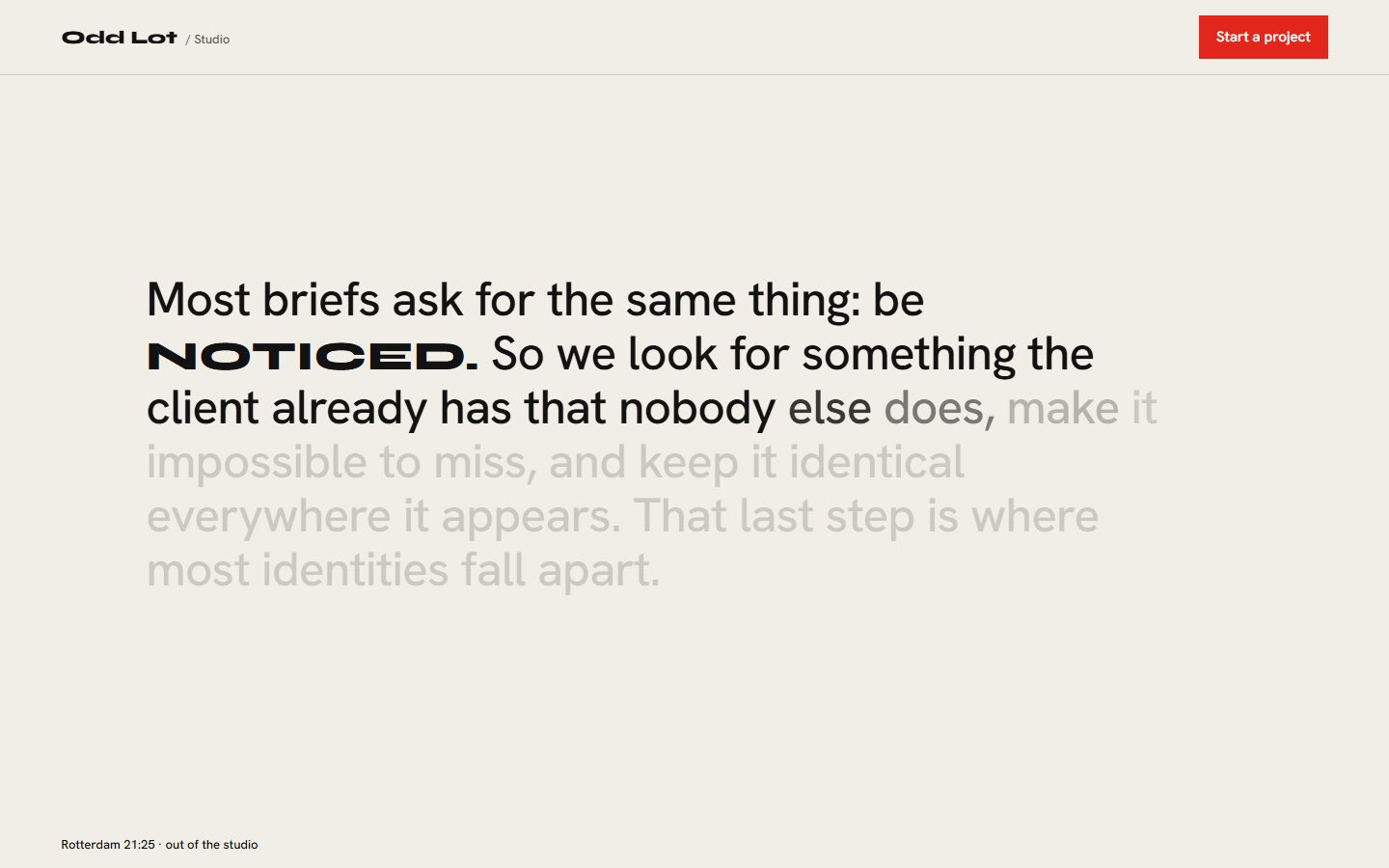
| read-fill | The studio's one statement, read with the visitor | Scroll scrub | Statement |
| typewriter | The page addressing the visitor | Idle | Status corner |
| stretch | The action answering a hand | Hover / focus | "Start a project" buttons |
| giant-marquee | Title ground at the end | Autoplay continuous | Footer |
Shot list
| # | Scene | Copy | Shot / blocking | Light, colour | Build | Cut out | Length | Energy | Money frame | Mobile |
|---|---|---|---|---|---|---|---|---|---|---|
| 1 | Hero hero (flow) |
Name, descriptor, CTA, See the work | Wide. Name in four outline rows left 7/12; artboard 4:5 right with label and reel caption below | Black ground, white outline, blue/white fills, light band | outline-fill, reel, headline-swap | Push to paper: the index's first row is already in view under the fold | 100 vh | 8 | Row two filling blue while the light band crosses the artboard | Name three rows over a square artboard |
| 2 | Index index (flow) |
Selected work, five rows | MS rows of display type at 6.4 vw, meta in text face right | Paper, ink; preview in the client's colour | hover preview, select-box, cursor chip | Push | content | 4 → 9 on hover | Row 03 hovered: selection box, preview with the broadcast mark, red chip | Rows at 9.5 vw, tap selects, sheet at bottom |
| 2b | Project layer (fixed) | Title, brief, what we made, result, next | Full card in client colour; title 3 rows; artefact large; three short paragraphs | Client colour; artefact | open state function render(x, s) |
Jump back | — | 9 | Tidewater card mid-open, the clip edge still visible over the index | Same, stacked |
| 3 | Statement statement (pinned) |
Statement | CU of a paragraph, 3.4 vw, left-aligned to the index grid | Paper, ink, dim copy at 20 % | read-fill scrubbed | Push | 220 | 3 | Two-thirds lit, the cap word lit | 7 vw |
| 4 | Facts facts (flow) |
Facts, quote, clients | Three numerals at 9 vw in a row, quote below | Paper; numerals ink | odometer on enter | Push into black | content | 5 | Numbers landed | Stacked |
| 5 | Enquiry enquiry (flow) |
Offer, form, reassurance | Split: the visitor's card left (sticky), form right | Black; card blue; red button | outline-fill on input, form, confirmation | Push | content | 6 → 8 on send | The card reading the visitor's title, last row red | Card on top, form below |
| 6 | Footer credits (flow) |
Marquee, fictional notice, fonts | Giant name marquee band, small print | Black, blue band | giant-marquee | — | content | 2 | — | Same |
The audience's part. Action: type a working title for your project. Response: the artboard sets it in the studio's outline rows as you type. Consequence: the title rides into the confirmation and the card's last row fills red when the brief is sent. Equivalent: any text input method; the form works without it.
Skeleton. Cold open on type (the loader is the name) → high (reel) → attentive low (index) with visitor-made spikes (each open) → quiet (statement, facts) → rising (enquiry) → ends on the visitor's words on the card: a rhyme with the opening rows.
Every production on this site is a fictional brand. The output is real: made by agents using the skill.